Mitigating Clinical Risks: A Guide for Australian Nursing Students Balancing Theory and Placement
The contemporary Australian healthcare system demands an unprecedented level of clinical precision, cognitive agility, and emotional resilience from its workforce. For nursing students navigating the transition from theoretical academic learning to real-world clinical placements, this environment presents a unique matrix of challenges. Placements within the Australian healthcare sector—ranging from major metropolitan tertiary hospitals to remote community clinics—require students to apply complex biomedical knowledge under direct supervision while adjusting to shifting shifts, multidisciplinary teamwork, and strict standardized compliance protocols.
However, the modern educational pathway presents significant operational hurdles. Nursing students frequently find themselves balancing rigorous academic schedules, comprehensive examinations, and extensive unpaid clinical placement hours, creating a high-pressure dynamic. Faced with concurrent deadlines, many undergraduates seek strategic academic support to maintain their performance profiles; those looking to safely navigate their foundational research modules often choose to utilize expert assistance to do my assignment australia, which allows them to protect their academic performance while focusing maximum energy on clinical skill acquisition. This tactical balance is crucial because errors in the clinical space carry severe consequences, impacting not only professional grading but, more importantly, patient outcomes and safety standards.
Clinical risks in nursing education are broad, ranging from medication administration errors and procedural lapses to communication breakdowns during critical patient handovers. According to reports from Australian healthcare safety bodies, cognitive fatigue and systemic workload pressures are significant contributors to medical errors among transitional practitioners. Therefore, developing a systematic approach to identifying, assessing, and mitigating clinical risks during placement is essential. This guide provides an evidence-based roadmap for Australian nursing students to manage clinical risks effectively, optimize their learning experiences, and maintain high standards of patient care without compromising their academic progression.
Key Takeaways
- Proactive Risk Mitigation: Clinical safety relies heavily on open communication, structured handovers, and strict adherence to the NMBA Registered Nurse Standards for Practice.
- Workload Equilibrium: Balancing academic theory with clinical practice requires strategic time management, peer support networks, and targeted academic assistance.
- Documentation Mastery: In Australian healthcare settings, objective, continuous, and clear documentation acts as a vital tool for defense and patient protection.
- Evidence-Based Practice: Aligning daily ward workflows with current clinical literature reduces operational errors and improves patient outcomes.
The Structural Architecture of Clinical Risks in Australian Healthcare
To mitigate risk effectively, a nursing student must understand the operational ecosystem of Australian clinical care. The National Safety and Quality Health Service (NSQHS) Standards provide the overarching quality framework across Australian hospitals and healthcare providers. These standards are designed to protect the public from harm and ensure high-quality care delivery. For an undergraduate nurse, entering this pre-regulated environment requires rapid acclimatization to specific localized risks.
Medication errors consistently rank among the most common adverse events in clinical environments globally and within Australia. The Australian Commission on Safety and Quality in Health Care (ACSQHC) notes that medication-related complications contribute to significant preventable harm annually. For students, the risk is compounded by unfamiliarity with electronic medication management software, complex dosage calculations, and the fast-paced nature of ward rounds. Lapses often occur when students are rushed or fail to complete the required independent double-checks for high-alert medications, such as insulin, anticoagulants, and narcotics.
Another major structural risk centers around communication failures, particularly during patient transitions and shift handovers. The ISBAR (Introduction, Situation, Background, Assessment, Recommendation) protocol has been adopted across various Australian state health departments—including NSW Health, Queensland Health, and Victoria’s Department of Health—to standardize clinical communication. Despite this standardization, students often struggle to present concise, clinically relevant data under pressure, which can lead to critical details about a patient’s deteriorating condition being missed during handovers.
The Dual-Front Challenge: Academic Commitments vs. Clinical Demands
The core struggle for the modern nursing student is managing the concurrent demands of university course requirements and professional clinical placements. A typical clinical rotation requires full-time attendance, often consisting of rotating morning, afternoon, and night shifts totaling 38 to 40 hours per week. When combined with travel times, mandatory pre-briefings, and reflection portfolios, students have minimal time left for traditional academic study.
This division of attention can lead to severe cognitive fatigue, a known precursor to clinical errors. Research indicates that sleep-deprived clinicians experience decreased situational awareness, slowed reaction times, and impaired clinical reasoning. When a student spends their evenings researching complex pathophysiology or writing extended nursing care essays, their focus during the following day’s clinical shift may be compromised. This makes balancing academic pressures particularly critical.
Operational Clinical Risk Matrices in Australian Wards
| Risk Domain | Primary Trigger Factor | Strategic Mitigation Protocol | National Alignment |
| Medication Lapses | Calculation errors, rushing, skipping double-checks | Strict adherence to the 7 Rights; mandatory independent secondary verification. | NMBA Standards compliance |
| Communication Breakdown | Vague handovers, intimidation within teams | Rigid implementation of the ISBAR framework; active communication. | NSQHS Standard 6 |
| Cognitive Overload | Dual-front academic/placement stress, fatigue | Strategic assignment outsourcing, structured shift scheduling. | Self-care frameworks |
| Procedural Lapses | Unfamiliarity with specialized ward equipment | Immediate escalation to clinical facilitators; review of hospital guidelines. | Evidence-Based Practice |
To safely manage these dual responsibilities, students must actively utilize available support systems. Managing specialized medical literature, refining clinical case studies, and keeping up with evidence-based research require focused academic effort. For students facing intense practical schedules, utilizing specialized nursing assignment help can be an effective way to delegate theoretical research tasks. This approach allows students to dedicate their on-site hours to mastering clinical competencies while ensuring their academic documentation remains rigorous and evidence-based.
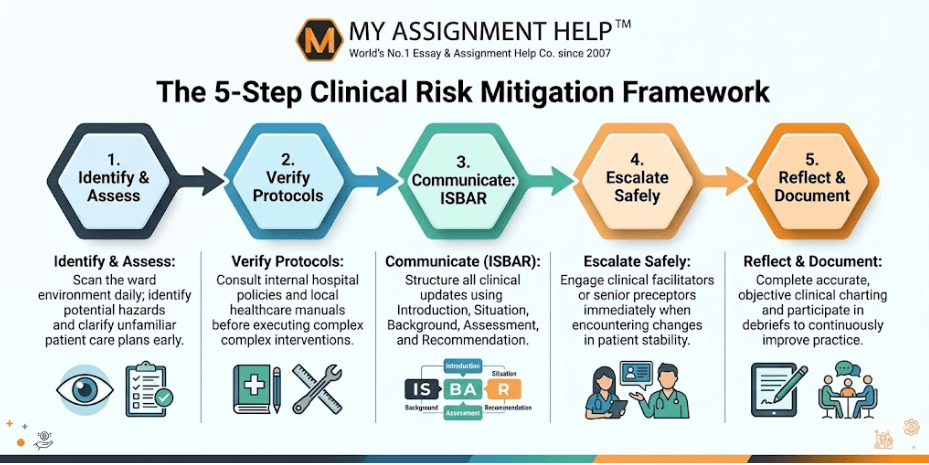
Infographic Breakdown: The 5-Step Clinical Risk Mitigation Framework
[1. Identify & Assess] ──> [2. Verify Protocols] ──> [3. Communicate: ISBAR] ──> [4. Escalate Safely] ──> [5. Reflect & Document]
- Identify & Assess: Scan the ward environment daily; identify potential hazards and clarify unfamiliar patient care plans early.
- Verify Protocols: Consult internal hospital policies and local healthcare manuals before executing complex interventions.
- Communicate (ISBAR): Structure all clinical updates using Introduction, Situation, Background, Assessment, and Recommendation.
- Escalate Safely: Engage clinical facilitators or senior preceptors immediately when encountering changes in patient stability.
- Reflect & Document: Complete accurate, objective clinical charting and participate in debriefs to continuously improve practice.
Operationalizing Safety: Navigating the NMBA Standards on the Ward
The Nursing and Midwifery Board of Australia (NMBA) sets out the explicit criteria required to maintain registration and protect public safety through its Registered Nurse Standards for Practice. For a student nurse, these standards serve as both a legal obligation and a practical guide for clinical decision-making. Specifically, Standard 1 (Thinks critically and analyses nursing practice) and Standard 6 (Provides safe, appropriate and responsive quality nursing practice) direct how students should manage risk on the floor.
Applying these standards requires students to recognize the limits of their current scope of practice. Undergraduates often face subtle pressure to perform tasks outside their approved competency level due to ward busy-ness or staffing shortages. A student might be asked by a busy registered nurse to administer an intravenous medication independently or perform a complex wound dressing without direct oversight. In these situations, risk mitigation involves politely but firmly stating their educational boundary, referencing their university’s guidelines, and requesting the necessary level of supervision. This proactive boundary management prevents procedural errors and upholds professional accountability.
Additionally, keeping up with evidence-based practice (EBP) is vital for ensuring clinical safety. Nursing treatments change as new research emerges, and techniques learned in a simulation lab may be updated by the time a student reaches a specialized ward. Students should actively check local hospital intranets for the latest clinical policy updates. Grounding their daily practice in current peer-reviewed evidence allows students to avoid outdated, higher-risk habits and deliver safer, contemporary patient care.
The Role of Clinical Documentation as a Defensive Risk Tool
In contemporary Australian healthcare, documentation is a core component of clinical care. The phrase “if it wasn’t documented, it didn’t happen” remains a central tenet of medical-legal safety. For nursing students, clear and precise documentation is essential for ensuring continuity of care and protecting themselves against potential allegations of negligence or error.
Effective clinical charting must be objective, timely, and precise. Students should avoid subjective language, such as “the patient slept well” or “the patient appeared agitated,” and instead record observable, measurable data: “Patient observed sleeping from 0100 to 0500 hours; respirations regular at 16 breaths per minute, unlaboured” or “Patient pacing corridor, speaking with an elevated tone, refusing scheduled oral medications.” Documenting care immediately after an intervention, rather than delaying it until the end of a shift, reduces the risk of forgetting important clinical metrics like fluid balance entries or vital sign trends.
Furthermore, accurate documentation helps the wider multidisciplinary team spot early signs of patient deterioration. Using tools like the Adult General Observation (AGG) charts or electronic early warning systems (e-EWS) helps track vital signs against clear thresholds for escalation. When a student nurse accurately records a rising respiratory rate or a falling blood pressure trend, they provide the necessary data for timely medical intervention, effectively mitigating the risk of serious adverse events on the ward.
Psychological Safety and Overcoming the Hierarchy Barrier
A significant but often overlooked barrier to clinical safety in nursing education is the hierarchical nature of hospital environments. Nursing students can sometimes feel intimidated by senior medical staff, experienced nursing directors, or even their immediate preceptors. This clinical hierarchy can lead to hesitation when a student needs to speak up about a safety concern, question an unusual prescription, or report an accidental mistake.
Creating a culture of psychological safety is essential for reducing these risks. Students need to know that their voices are valid when it comes to maintaining patient safety. If a student notices a discrepancy in a medical chart or suspects a patient is receiving an incorrect medication dose, they have a professional responsibility to speak up. Using structured communication phrases like “I have a safety concern regarding this order” or “I need clarity on this procedure before we proceed” can help overcome communication barriers and ensure potential issues are addressed constructively.
If an error does happen, immediate disclosure is crucial. Trying to hide a clinical mistake out of fear of disciplinary action can worsen patient risks and constitutes a serious breach of professional ethics. Australian hospitals operate under open disclosure policies, which encourage transparent communication when things go wrong. Reporting a lapse immediately allows the clinical team to take swift corrective action, such as administering an antidote or increasing observations, while providing a valuable learning opportunity to prevent future occurrences.
See also: Benefits of Freeze-Dried Beef Liver for Cats: Energy, Coat Health, and More
Frequently Asked Questions (FAQs)
1. What should I do immediately if I commit a medication error while on placement?
Your absolute priority is patient safety. Immediately notify your supervising Registered Nurse and your university clinical facilitator. Do not attempt to conceal the error. Assess the patient’s immediate vital signs, assist the medical team in implementing any required mitigation strategies, and complete the hospital’s internal incident report (such as a RiskMan or IIMS entry) alongside an objective entry in the patient’s medical record.
2. How do I handle a situation where a preceptor asks me to perform a task outside my scope of practice?
Politely decline by clearly stating your educational boundaries. You can say: “As an undergraduate student, this procedure falls outside my current university scope of practice, and I am not permitted to perform it without direct supervision. However, I would value the opportunity to observe you perform it if time permits.” This maintains professional boundaries while demonstrating an active willingness to learn.
3. How does the ISBAR framework improve safety during shift handovers?
ISBAR standardizes communication by breaking information down into Introduction, Situation, Background, Assessment, and Recommendation. This structure prevents communication errors by ensuring that critical clinical data, such as trending vital signs or recent diagnostic results, is delivered clearly and concisely, reducing the risk of vital patient information being missed between shifts.
4. Can utilizing external academic assistance compromise my professional standing?
Utilizing professional, high-quality tutoring and academic research support agencies for preparatory model work, proofreading, and structuring complex research papers is a legitimate way to manage heavy workloads. It allows students to reduce cognitive fatigue, improve their understanding of complex topics, and focus more effectively on developing practical clinical skills during intensive placement blocks.
About the Author
Sarah Jenkins (RN, MNS) is a Senior Clinical Education Specialist and Senior Content Contributor at MyAssignmentHelp. With over twelve years of acute-care nursing experience within major Australian metropolitan hospitals and a Master’s degree in Nursing Science, Sarah specializes in workforce preparation, clinical risk management, and supporting undergraduate nurses through their transitional placements. She works closely with academic development teams to design comprehensive, evidence-based learning resources that help nursing students bridge the gap between classroom theory and practical ward care.
References & Evidence-Based Data Sources
- Australian Commission on Safety and Quality in Health Care (ACSQHC). (2021). National Safety and Quality Health Service (NSQHS) Standards. Sydney: ACSQHC.
- Nursing and Midwifery Board of Australia (NMBA). (2016). Registered Nurse Standards for Practice. Melbourne: AHPRA.
- Australian Government Department of Health and Aged Care. (2023). National Health and Medical Research Council (NHMRC) clinical guidelines on patient safety metrics. Canberra: Commonwealth of Australia.
- Aisbett, C., & Levett-Jones, T. (2022). Application of the ISBAR communication tool among undergraduate nursing students during high-stress clinical transitions. Australian Journal of Advanced Nursing, 39(2), 34-42.
- Johnstone, M. J., & Kanitsaki, O. (2020). Clinical hierarchy, psychological safety, and the risk mitigation behaviors of student nurses in acute care settings. International Journal of Nursing Studies, 104, 103-112.